Fish Iowa - Fish Species - Southern Redbelly Dace
Characteristics
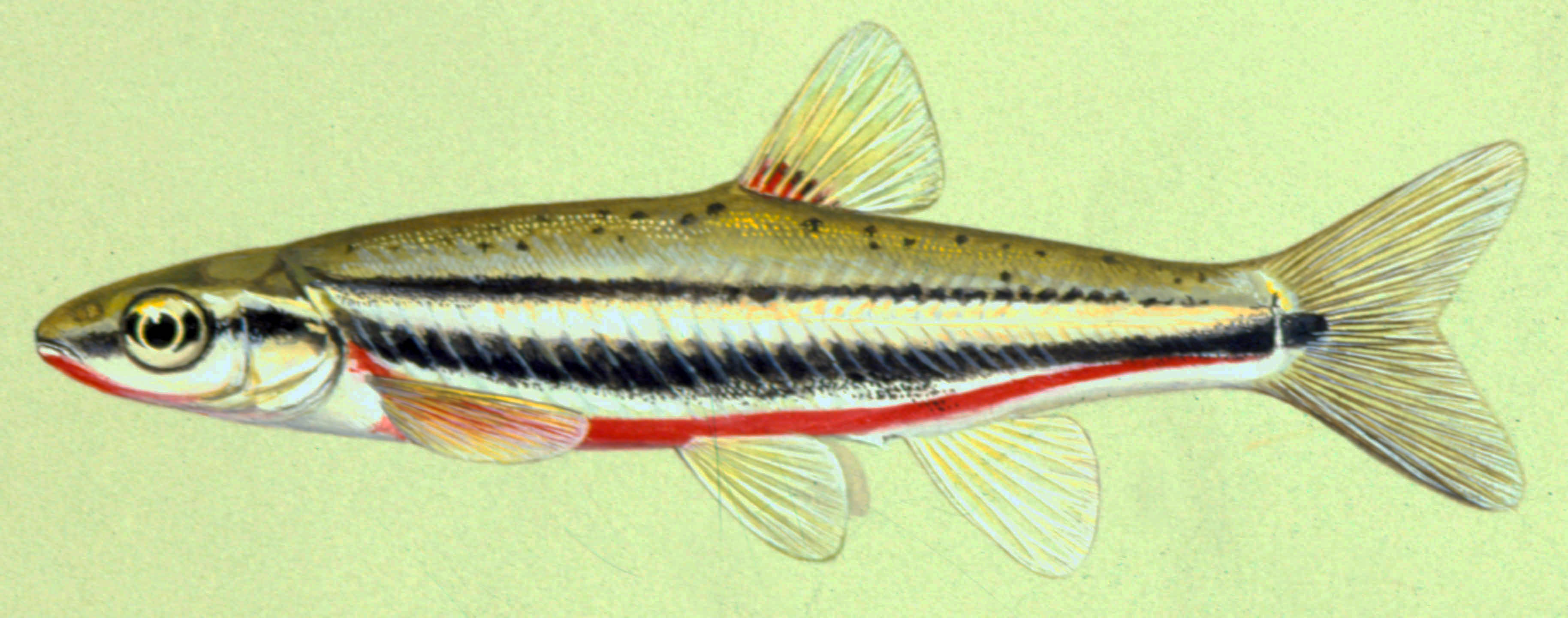
One of the most beautiful fish in Iowa. Its body is elongate and almost cylindrical. There are two distinguishing characteristics which set it apart from other minnows. The scales are tiny, almost requiring magnification to be seen. The coloration is unique. A cream-colored lateral band is layered between dark bands on the sides. The top dark band starts at the edge of the opercle and turns into a series of spots on the caudal peduncle. The lower band circles the snout and ends in the basicaudal rays of the tail. There are black dots along the back before the dorsal fin, and the mid-dorsal stripe may also look like a series of dots. Males have purplish-red splotches on the chest, chin, belly, and on the base of the dorsal fin, and their fins are bright yellow. Females vary from plain to washed with pink. The snout is blunt with a terminal mouth, in which the upper jaw slightly extends past the lower jaw. Presence of a barbel is unusual, but at least one population has been found which has barbels on each side of the jaw. There are 65 to 90 scales along the incomplete lateral line. The pharyngeal formula is 5, 5, and the teeth are slender with slight hooks, and occasionally a pattern of 5, 4 may be present. The dorsal, anal, and pelvic fins have 8 rays, and the pectorals have 14 or 15. The intestine is long, with two coils and a loop with a black peritoneum.
Foods
- No results found
Expert Tip
These minnows are difficult to keep in an aquarium, but the effort is rewarded by the dazzling color display.
Details
The Southern Redbelly Dace lives in the clean, cool headwaters of small streams. It is a secretive fish seeking escape cover under overhanging banks or other structures. Permanent spring flows provide micro-habitat for the scattered populations away from northeast Iowa.
Spawning of Southern Redbelly Dace occurs from May through July over silt-free, gravel bottomed riffles. The nests of other stream minnows may be used to deposit eggs. Spawning takes place in schools with two males usually accompanying a female. Egg production varies from 200 to over 6,000 eggs. Adults may reach 3-inches long.
The Southern Redbelly Dace was first listed in the genus Chrosomus, but it is currently in the genus Phoxinus, which links the native genus to the old world genus of the same name.
Recent stream sampling information is available from Iowa DNR's biological monitoring and assessment program.
Distribution Map
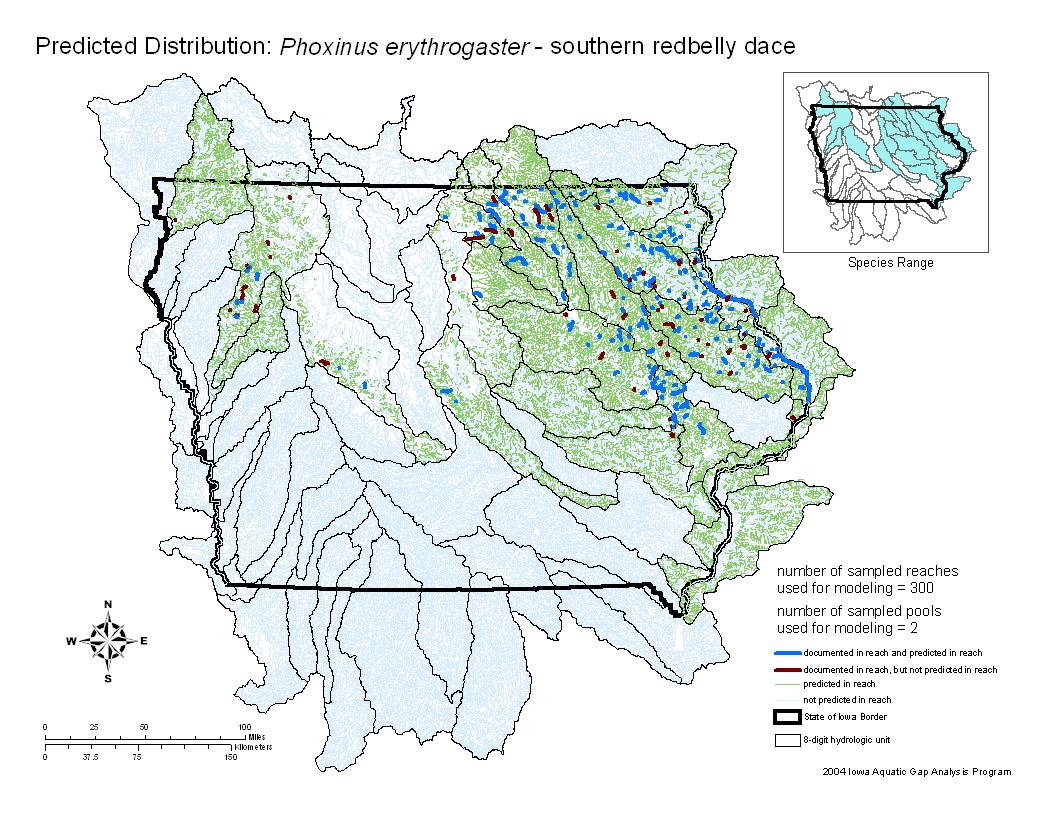
Throughout the upper portions of the Winnebago, Shellrock, Wapsipinicon, Turkey, Maquoketa, and Misssissippi rivers in northeast Iowa. Scattered populations in northwest, central, and east-central streams.
See our most recent distribution data for this species on the Iowa DNR's Bionet application.
State Record(s)
No state record exists for this species
Submit your potential recordMaster Angler Catches
No Master Angler catches currently exist for this species.
Submit your Master Angler catchFish Surveys
Tip: Click Species Length by Site, then use the dropdown to filter by fish species of interest.Where this Fish Is Found
Baileys Ford
Bass Creek
Bigalk Creek
Bloody Run Creek
Bohemian Creek
Brush Creek
Hewett and Ensign Creeks (Ensign Hollow)
Joy Springs
Little Turkey River
Maquoketa River (trout portion)
Miners Creek
Monastery Creek
Mossy Glen
Otter Creek
Paint Creek
Richmond Springs
South Cedar Creek
Swiss Valley Creek
Tete des Morts River
tributaries to Tete des Morts River
Twin Bridges
Upper Swiss Valley Creek
Wapsi River (Trout Section)
White Pine Hollow